
Trauma-Informed Mentorship Activity: Build a Bridge for Foster Youth
Feb 11, 2026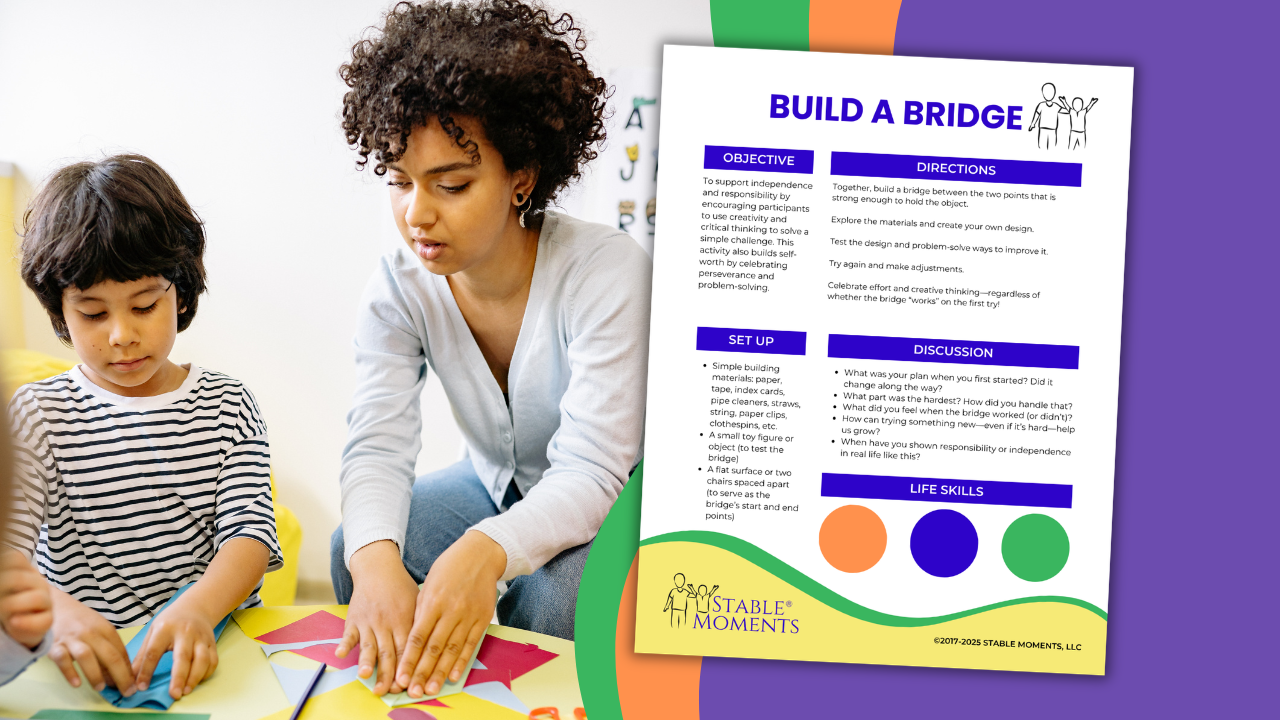
If you’ve ever worked with the kids we serve, you’ve probably seen this moment:
You introduce something new.
They hesitate.
Or they rush in impulsively.
Or they say, “I can’t.”
Or they try once, it doesn’t work, and they shut down.
Children who have experienced early developmental trauma often learned very young that mistakes aren’t safe.
Some grew up in chaos where no one helped them problem-solve.
Some were shamed when things didn’t work.
Some learned that trying and failing meant rejection.
 So when something collapses in front of them, their nervous system doesn’t just see a failed structure.
It can feel like personal failure.
That’s why we are so intentional about the activities we choose.
And that’s why Build a Bridge is so powerful.
Trauma-Informed Mentorship Activity: Build a Bridge for Foster Youth
At its core, this activity is simple.
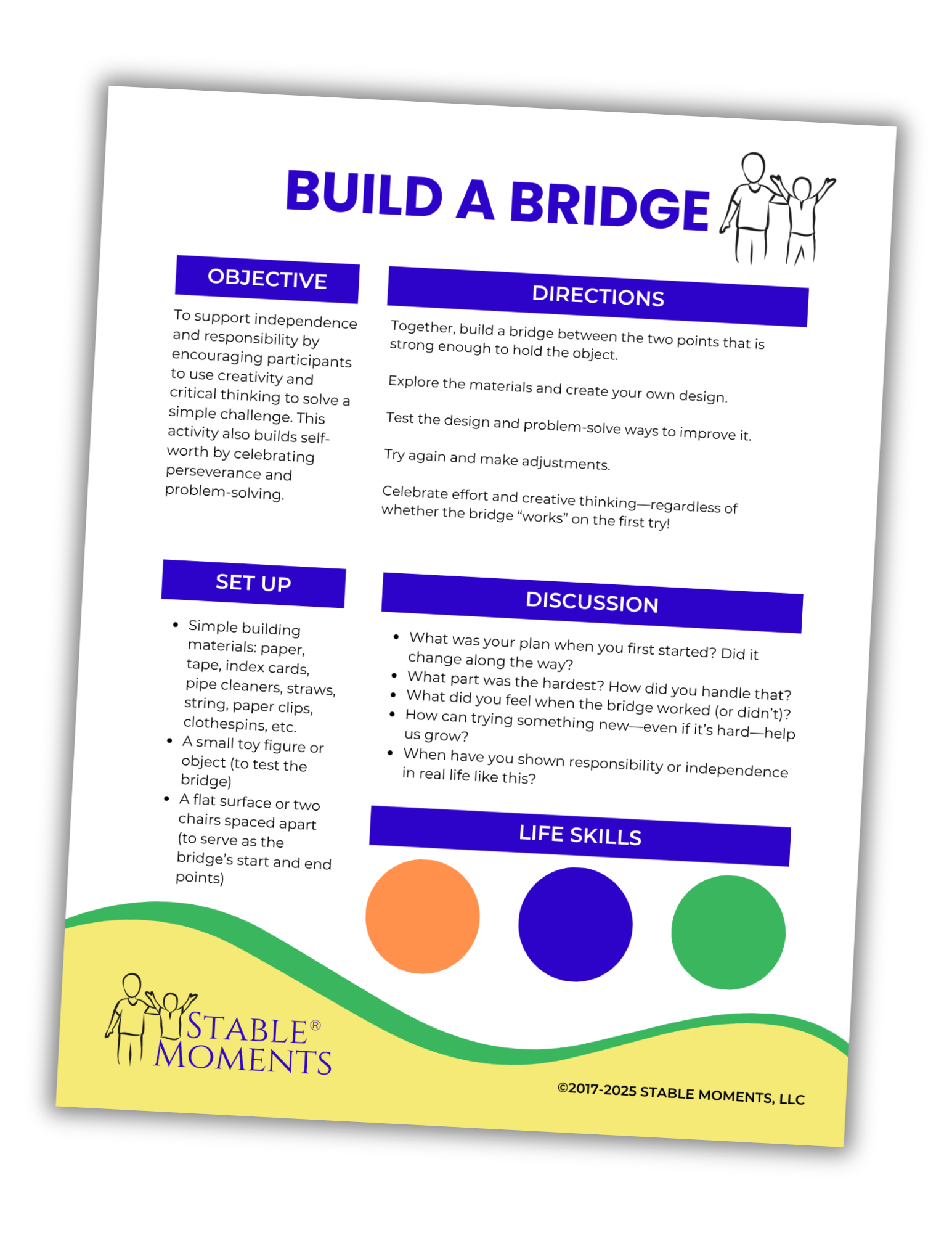
Together, build a bridge between two points that is strong enough to hold an object.
Explore the materials and create your own design.
Test the design and problem-solve ways to improve it.
Try again and make adjustments.
Celebrate effort and creative thinking, regardless of whether the bridge works on the first try.
The objective is to support independence and responsibility by encouraging creativity and critical thinking to solve a simple challenge. It also builds self-worth by celebrating perseverance and problem-solving.
Materials can be simple: paper, tape, index cards, pipe cleaners, straws, string, paper clips, clothespins.
You’ll need:
-
A small object or toy figure to test the bridge
-
A flat surface or two chairs spaced apart to serve as the start and end points
That's it.
But what’s happening underneath is much bigger.
Start Small. Then Expand.
You might begin with something very manageable.
A small bridge on a tabletop using popsicle sticks, paper, and tape.
Short distance. Low pressure. Quick wins.
When confidence builds, you can stretch it.
Move to two chairs spaced across the room.
Increase the gap.
Increase the challenge.
Now the child isn’t just building a structure. They’re building belief.
“I did something small.”
“Now I can try something bigger.”
That progression matters.
Trauma-informed mentorship is not about overwhelming kids. It’s about scaffolding confidence.
What This Activity Builds
🟠 Independence
Many of our kids have either been over-controlled or under-supported.
Independence grows when a child is trusted to think.
Instead of fixing the design, ask:
-
“What’s your plan?”
-
“What do you think might make it stronger?”
-
“What could you try next?”
Let them own the solution.
Even if the first bridge collapses.
Especially if it does.
🔵 Responsibility
Responsibility is not just chores and rules.
It’s:
-
Making a plan
-
Testing it
-
Adjusting when it doesn’t work
-
Staying engaged instead of quitting
When the bridge falls, that’s the moment.
If a child says, “This is stupid,” or pushes materials away, that’s not defiance. It’s protection.
You respond with curiosity:
“Let’s look at what happened. Where do you think it bent?”
You’re teaching that problems are solvable.
🟢 Self-Worth
This might be the most important piece.
Children who have experienced instability often internalize:
“If it didn’t work, I didn’t work.”
So when the structure fails, they may feel shame before they even have words for it.
That’s why celebrating effort is not optional. It’s the intervention.
Say:
“I love how you kept trying.”
“You didn’t give up.”
“That was creative thinking.”
You are separating outcome from identity.
The bridge failed.
You did not.
That rewiring builds self-worth.
Processing the Experience
After the build, reflect together.
Some of the discussion prompts include:
- What was your plan when you first started? Did it change?
-
What part was the hardest? How did you handle that?
-
What did you feel when the bridge worked or didn’t?
-
How can trying something new help us grow?
-
When have you shown responsibility or independence like this in real life?
If a child shrugs and says, “I don’t know,” that’s okay.
You can offer language:
“Sometimes when something falls, people feel frustrated. Did it feel frustrating or surprising?”
We are building emotional awareness alongside problem-solving.
The Bigger Picture
This is never just about engineering.
It’s about building an internal bridge.
From:
-
“I can’t” to “I can try.”
-
Collapse to rebuilding.
-
Shame to perseverance.
When we give a child the space to fail safely and try again, we are strengthening neural pathways that support resilience.
And resilience changes trajectories.
Kids who believe they can rebuild a bridge are more likely to believe they can rebuild a relationship, a grade, a goal, even a future.
That’s why we do this.
Not for the paper and tape.
But for the moment a child looks at something they created and says,
“I did that.”
And means it.
If you’re a mentor, try Build a Bridge this month.
Start small.
Stretch bigger.
Celebrate effort.
And remember, every time they rebuild that structure, they’re rebuilding something inside themselves too.
Want to Launch a Stable Moments Program?
If this activity resonates with you, imagine having access to an entire library of color-coded, trauma-informed activities intentionally designed to build life skills in kids who have experienced unstable beginnings.
When you become certified to run a Stable Moments program, you receive:
-
Our full set of color-coded life skills activities
-
The complete Stable Moments Manual
-
Immediate access to our Certification Course
-
Step-by-step guidance to launch and operate your program
Certification is open to schools, churches, and community-based organizations that want to provide structured, trauma-informed mentorship in their community.
You don’t have to create the model.
You don’t have to guess what works.
We’ve built it.
Now you can bring it to your community.
👉 Learn more about becoming a Stable Moments location here.
One child. One hour a week. One life changed.
Learn how to launch a program today.
Get new activities and trauma tidbits straight to your inbox!
We hate SPAM. We will never sell your information, for any reason.

